
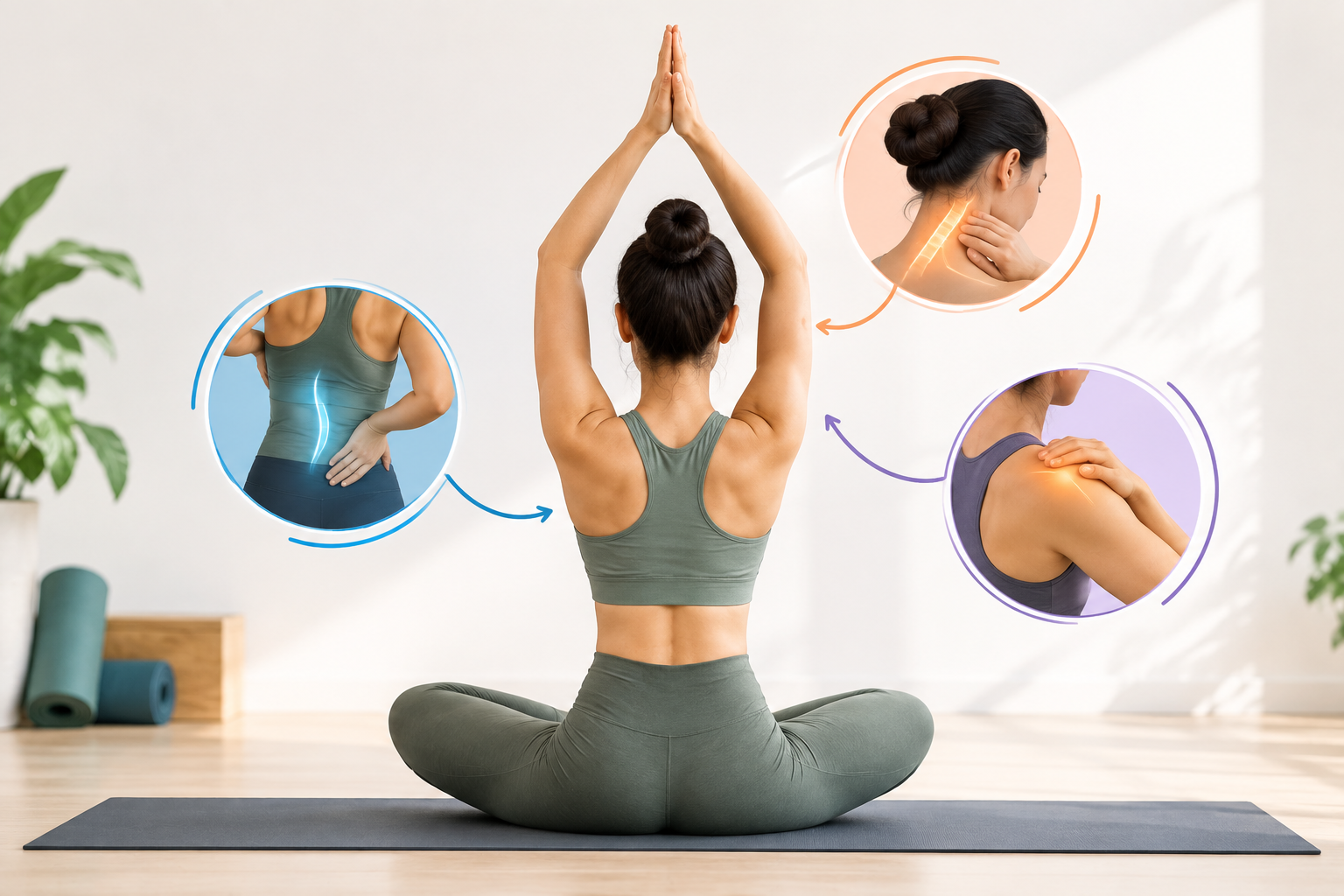
You sit down at your desk in the morning and before you know it, half the day is gone.
By the afternoon, your shoulders feel tight, your neck starts bothering you and your lower back feels uncomfortable.
Sound familiar?
Back, neck and shoulder stiffness is common among people who spend a lot of time sitting, working on computers or using their phones.
One thing many people try is stretching. Yoga is a good place to start if your aim is to keep your body moving and improve flexibility. You don’t need complicated poses or advanced flexibility. A few simple yoga exercises can be a sensible starting point.
Why Does Your Body Feel Stiff After Sitting?
When you sit in the same position for several hours, your shoulders may move forward, your head may come closer to the screen and your lower back stays in almost the same position.
Lack of exercise, repetitive movements, poor sleeping positions, stress and previous injuries can also affect how your muscles and joints feel.
This does not mean every ache is caused by poor posture. Pain can have many causes, so ongoing or severe pain should not simply be ignored or treated with random exercises.
For general stiffness, regular movement is a good habit, and yoga for flexibility can be one way to include it in your routine.
1. Cat Cow Stretch
Cat Cow is one of the easiest yoga stretches to add to your routine, especially if your back feels stiff after sitting.
How to do it
Start on your hands and knees with your hands under your shoulders and knees under your hips.
Slowly arch your back while lifting your chest slightly. Then round your back and bring your chin gently toward your chest.
Keep the movement slow and comfortable. Try 6 to 10 repetitions. Start with a smaller range if your back feels stiff.
Why it can be useful
Cat Cow gives your spine controlled movement and can be a good warm-up before other stretches. If the movement causes pain rather than comfortable movement, stop and get professional advice.
2. Child’s Pose
Child’s Pose is a simple position that many people find comfortable when their back feels tight. It can also be included in a routine focused on yoga for flexibility.
How to do it
Start on your hands and knees.
Slowly move your hips back toward your heels and extend your arms forward. Let your head and neck relax rather than forcing them toward the floor.
Stay for around 20 to 30 seconds while breathing normally. If your hips don’t reach your heels comfortably, don’t force the position.
If you have knee problems or the position causes discomfort, choose another movement.
3. Thread the Needle
Your upper back can get just as stiff as your lower back, particularly if you spend most of your day working at a computer.
Thread the Needle involves gentle rotation through the upper back and shoulder area.
How to do it
Start on your hands and knees. Keep your left hand on the floor and slowly slide your right arm underneath your left arm.
Allow your upper back and right shoulder to turn naturally.
Return to the starting position and repeat on the other side. Start with 5 to 8 repetitions on each side.
Why include it?
This exercise gives the upper back and shoulders a chance to move, particularly in an area that may not get much rotation during the day.
4. Standing Side Stretch
A standing side stretch takes less than a minute and doesn’t require a mat, equipment or much space. It can be a useful addition to a flexable yoga routine.
How to do it
Stand comfortably with your feet apart.
Raise your right arm overhead and slowly lean toward your left side without twisting your body.
Hold for 15 to 30 seconds, then return to the centre and repeat on the other side.
Keep both feet on the floor and don’t push yourself further just because you think you should stretch more.
You can add this stretch after sitting for a couple of hours. Small movement breaks can make it easier to avoid staying in the same position throughout the workday.
5. Gentle Neck Stretch
The neck is one area where stretching needs to be approached carefully.
If your neck feels stiff after hours of looking at a laptop or phone, a simple side stretch may help you move the area comfortably.
People often search for yoga poses for neck and shoulder pain, but these movements should be used for gentle mobility rather than as a guaranteed treatment for pain.
How to do it
Sit or stand comfortably.
Relax your shoulders and keep your back in a natural position. Slowly bring your right ear toward your right shoulder and stop when you feel a mild stretch on the opposite side of your neck.
Hold for a few seconds, return to the centre and repeat on the other side.
You can also slowly turn your head from side to side within a comfortable range.
There is no need to pull your head down with your hand. If you feel sharp pain, dizziness, numbness or tingling, stop and speak with a healthcare professional.
How Much Yoga Do You Actually Need?
You don’t need to start with a one-hour yoga session.
If you are not currently exercising, start with five to ten minutes and make movement part of your routine.
If you spend most of your day sitting, get up regularly, walk around, stretch your legs and change your position.
Want Better Flexibility? Don’t Force It
Flexibility is not about touching your toes or doing a full split. It is also about everyday movements such as turning your head comfortably, reaching overhead or bending down without unusual stiffness.
If you are doing yoga for flexibility, give yourself time. Your body will not become more flexible overnight. Move regularly and let your range of movement improve gradually.
Things to Avoid When Stretching
Don’t stretch through sharp or intense pain.
Don’t bounce aggressively while stretching. Slow, controlled movements are a better choice.
Don’t compare your flexibility with other people. Everyone starts at a different level.
If the same pain keeps returning despite stretching, consider getting the problem assessed.
Can Yoga Improve Back, Neck or Shoulder Flexibility?
Yoga can be a useful way to include regular movement and stretching in your routine, but it is not suitable for every type of pain or condition.
If your discomfort is mild and related to general stiffness, staying active and including yoga may be helpful.
However, if pain has lasted a long time, keeps returning or affects your daily life, a professional assessment can help determine what type of treatment or exercise is appropriate.
Depending on the individual, this could include physiotherapy, rehabilitation or chiropractic care.
When Is It Time to See a Professional?
Get professional advice if your pain is severe or getting worse, started after an accident or injury, is accompanied by numbness, tingling or weakness, disturbs your sleep, affects normal activities or keeps returning.
These symptoms are a reason to find out what is causing the problem rather than continuing to manage it on your own.
Chiropractic and Rehabilitation Support in Kolkata
If you are based in Kolkata, Salt Lake, Bidhannagar or nearby areas and your back, neck or shoulder discomfort is affecting your routine, professional guidance may be worth considering.
Chiropractor 360° provides chiropractic care, physiotherapy and rehabilitation services for people dealing with different pain and movement-related concerns.
Rather than assuming that the same exercise works for everyone, a professional assessment can help identify what is affecting your movement.
Two people may both complain of back pain but have completely different reasons for experiencing it, so their treatment and exercise requirements may also be different.
Final Thoughts
Back, neck and shoulder stiffness is easy to dismiss when it comes and goes, but your body needs regular movement.
Simple yoga exercises such as Cat Cow, Child’s Pose, Thread the Needle, Standing Side Stretch and Gentle Neck Stretch can be useful additions to a daily routine when your goal is to maintain mobility and improve flexibility.
The best yoga stretches are not necessarily the most difficult ones. Choose movements that suit your body and that you can perform comfortably and consistently.
For people in Kolkata, Salt Lake, Bidhannagar and nearby areas, Chiropractor 360° offers chiropractic care, physiotherapy and rehabilitation services for pain and movement-related concerns.
FAQs
What are the best yoga stretches for back pain?
Cat Cow and Child’s Pose are two simple options that can help with general mobility. However, the right exercises depend on the reason behind your back pain.
Is yoga good for neck and shoulder stiffness?
Gentle yoga exercises can help keep the neck, shoulders and upper back moving. However, if your pain is persistent or accompanied by numbness, tingling or weakness, get professional advice before exercising.
How often should I do yoga for flexibility?
You can start with a few minutes each day. Regular practice is more useful than doing a long session occasionally.
Can beginners do these yoga exercises?
Yes. These movements can be suitable starting points for beginners, provided they are performed within a comfortable range. You don’t need previous yoga experience.
Can yoga completely get rid of back pain?
No exercise can guarantee that. Yoga may help some people with movement and flexibility, but back pain can have many causes. Persistent or severe pain should be assessed by an appropriate healthcare professional.
What should I do if stretching makes my pain worse?
Stop the exercise. Do not try to push through increasing pain. If the pain continues or is accompanied by symptoms such as numbness, tingling or weakness, seek professional advice



No comment